This property claim example follows one wind and hail claim in Oklahoma from the moment its documents are uploaded to the letter that closes it, and shows where the reading ends and the adjuster's judgement begins.
Example claim. The Vasquez claim is fictitious demo data: a wind and hail loss in Oklahoma on an HO3 policy. Names and figures are invented.
Each section below links to the matching screen in the property claim walkthrough, so you can see what the adjuster sees.
The claim arrives
Hail and high wind cross Oklahoma. The Vasquez family reports damage to their home and claims $89,247. What reaches the carrier is not yet a claim. It is a stack: the loss report, the repair estimate, the photos and the HO3 policy with its endorsements.
All four are uploaded together. The reading starts the moment the files land.
Read before anyone opens it
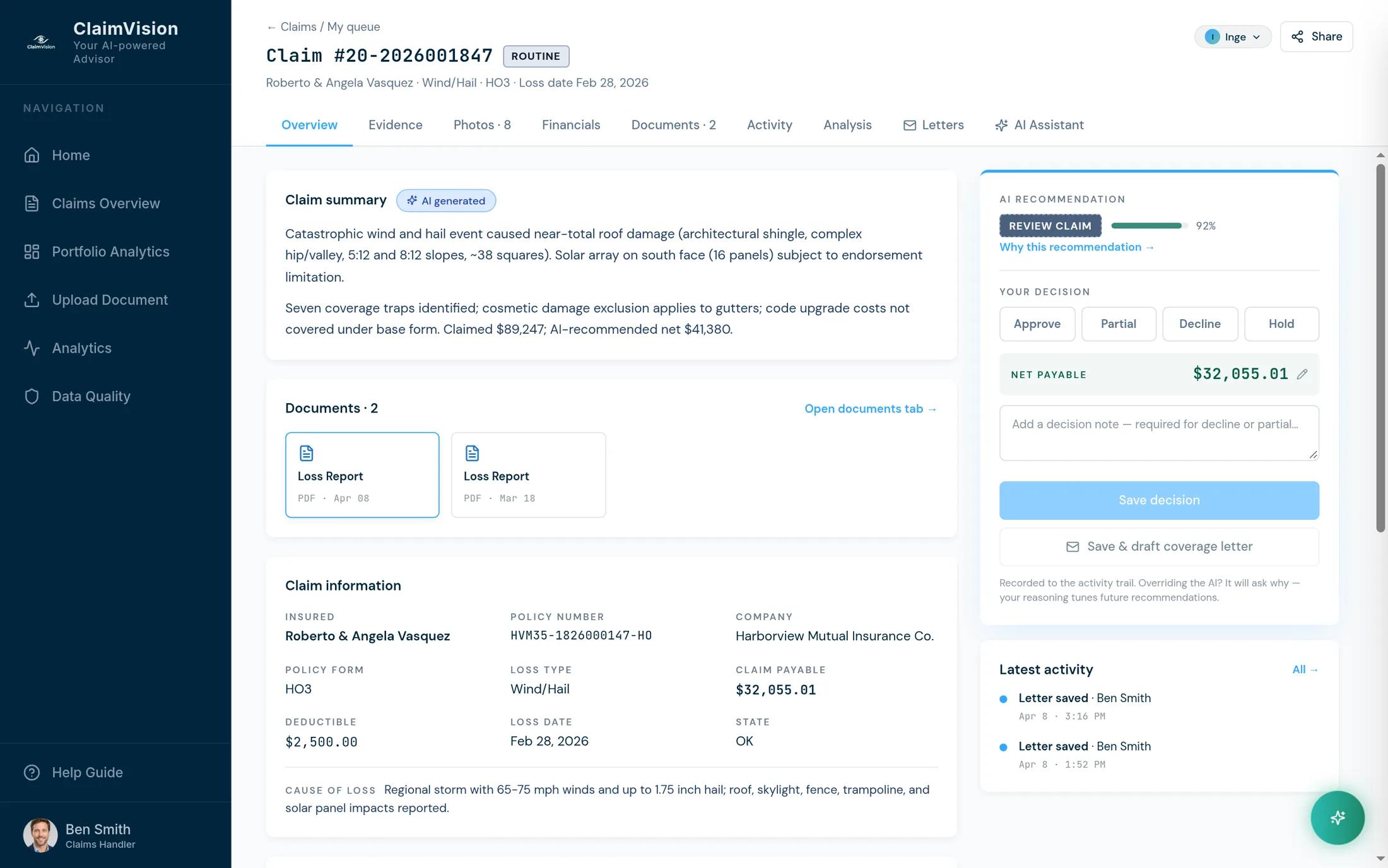
By the time the adjuster reaches the claim, it has already been read. In the claims overview, the Vasquez claim waits in the queue beside every other open file, with a recommendation, the payable amount and its age. Her first look is the claim, summarised, with the questions that need a person already marked.
Seven coverage traps, three with a price
The claim overview shows seven coverage traps on this claim. Three of them change the money directly:
- Solar panels. The policy limits what it pays for the solar panels on the roof. On the example claim, that limitation takes $6,200 off what was claimed.
- Gutters. Hail dents in the gutters change how they look, not how they work. Cosmetic damage is excluded, which takes off $3,800.
- Code upgrades. Repairing to current building code costs more than restoring what was there. The policy has no ordinance or law coverage, so the $4,200 for the upgrade is not covered.
None of them is hidden. They are written into the policy, waiting for someone to read it next to the estimate. Finding them on every claim is the job of policy coverage checking. Missed, they become claims leakage.
The questions only a person can settle
Other findings are questions for the adjuster:
- The skylight. Water came in around a skylight. Before the interior scope is final, it needs a mold assessment.
- Overhead and profit. The estimate includes a general contractor's overhead and profit. Paying it needs three-trade documentation.
- The fence. The insured may dispute the depreciation on the fence, so the reasoning needs to be written down before the letter goes.
Each finding points at the page or photo it came from, which you can check in the evidence step. That link is where the AI claims audit trail starts.
| Finding | What the file shows | Effect on the example claim |
|---|---|---|
| Solar panel limitation | The policy limits what it pays for solar panels | −$6,200 |
| Cosmetic damage to the gutters | Dents that change appearance, not function, are excluded | −$3,800 |
| Code upgrade costs | No ordinance or law coverage on the policy | −$4,200 |
| Skylight water intrusion | Water entered around the skylight | Mold assessment before the scope is final |
| Overhead and profit | Contractor overhead and profit is claimed | Needs three-trade documentation |
| Fence depreciation | Depreciation applies to the fence | The insured may dispute it |
The decision stays with the adjuster
The financials build the settlement line by line, so every deduction sits beside the reason for it. The adjuster rules on the open questions: what the mold assessment means for the scope, whether the three trades are documented, how to explain the fence. Then she approves, adjusts or overrides, and every override is kept, with the adjuster's reason when they add one.
We are not printing a net figure for this example on purpose. The net depends on how the adjuster rules, and that is the point.
The letter
The decision letter drafts itself from the decision: approve, edit, send. The reasons in the letter are the reasons in the file, so the family gets an explanation, not only a number. Every day saved here comes off the cycle clock, which is how you reduce claims cycle time without asking anyone to read faster.
Now imagine it is your policy forms. Bring a closed claim; thirty minutes is enough.
Book a demo