How is asking ClaimVision different from asking a chatbot?
A chatbot reads your documents when you ask and improvises an answer. ClaimVision has already turned every page of the claim into structured, checked data, so you can ask your claims data a question and the answer comes from the data, with the page attached.
Code for the facts, language for the conversation. Purpose-built claims logic extracts and checks the figures, the dates, the coverage and the endorsements; a language model lets your team question that data in plain English.
What sits under every answer
Is asking ClaimVision the same as asking a chatbot? No.
Anyone can put a chat window on top of a pile of PDFs. The work is in what the chat window is talking to.
Every page, as structured data
The estimate lines, limits, deductibles, dates and endorsements become claim data you can sort, total and compare, not paragraphs you have to search.
Checked before anyone asks
The figures reconcile and the coverage traps are found before the file is opened, each with its clause and its dollar impact.
Asked in plain English
Your team questions the claim the way they would question a colleague, and every answer points at the page it rests on.
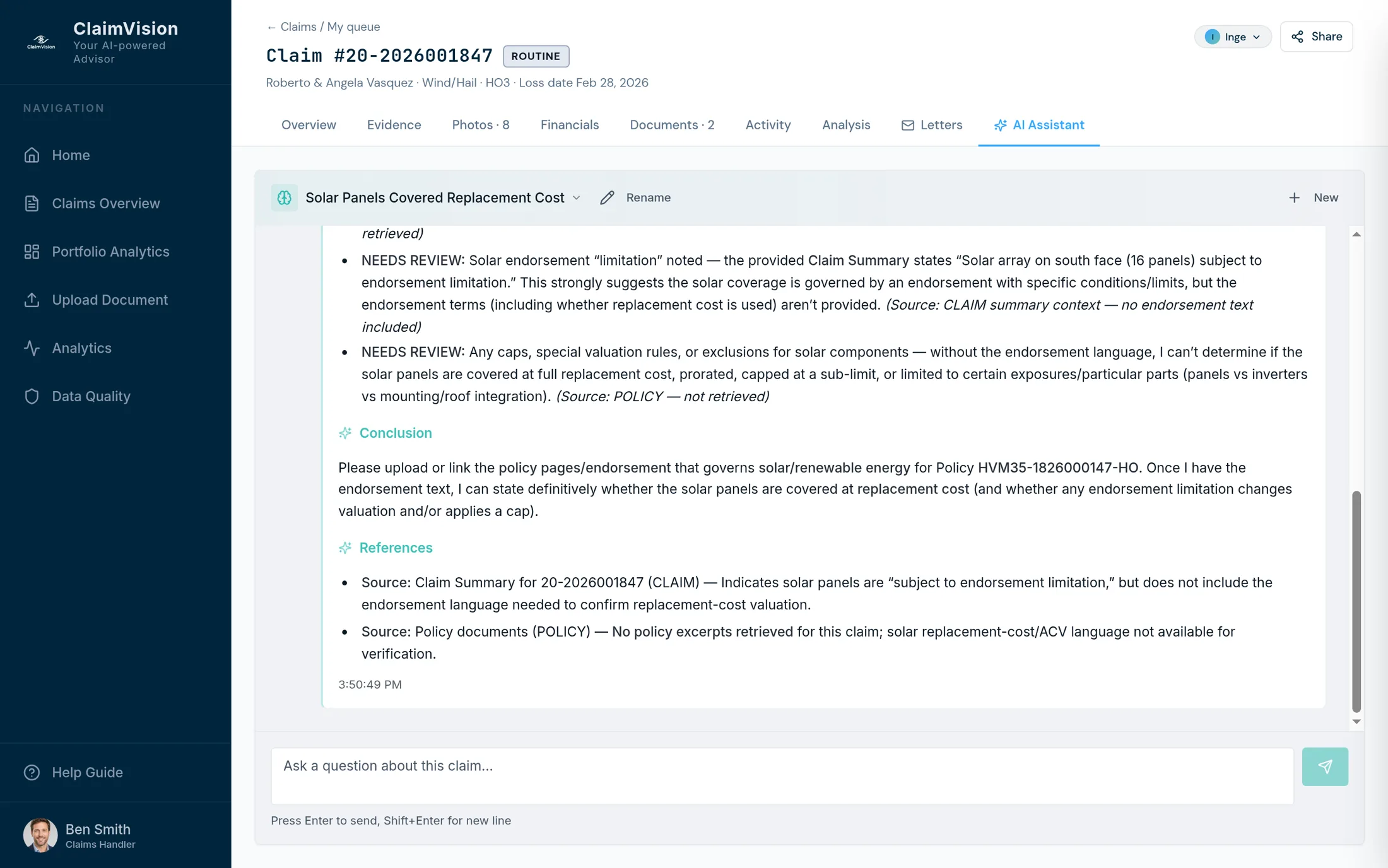
An example exchange
One question, and everything that comes back with the answer.
- The clause.
- Not a paraphrase: the operative sentence, highlighted in the document it came from, with the page reference.
- The number.
- The answer lands in dollars on this claim, and the figure is the same one the settlement will use, because it comes from the claim's data, not from a fresh guess.
- The honesty.
- When the data does not settle the question, ClaimVision says so and hands it to a person. Every answer, and every override of one, is kept in the AI claims audit trail.
The difference
Document search, a chatbot, structured claims data.
| You ask | Document search | A chatbot over the PDFs | ClaimVision |
|---|---|---|---|
| "Is the roof covered?" | Every page that mentions "roof". You do the reading. | A fluent summary, which may not have noticed the endorsement that overrides it. | Yes or no with basis: the clause it rests on and the settlement consequence in dollars. |
| "Do the numbers reconcile?" | Cannot answer; arithmetic is not retrieval. | Might compute; figures can drift between question and answer. | Line by line, from the claim's data, or flagged where it does not reconcile. |
| "Can I defend this in a file review?" | You keep your own notes. | The conversation scrolls away. | Every answer cited and kept in the audit trail, beside the decision it informed. |
The questions claims people really ask: "Why doesn't the estimate total match the statement of loss?" "Which exclusions could apply to the interior water damage?" "Walk me through how you got to the net payable." Each one gets the answer, the policy language behind it, and the number.
For the next generation
How does a new adjuster learn from it?
They ask the questions they would hesitate to ask a senior colleague twice.
Every answer arrives with the clause and the reasoning.
So it teaches the pattern, not just this claim.
More on adjuster training and capacity.
FAQ
Questions about asking your claims data
Can you ask questions of claims data in plain English?
Yes. ClaimVision turns every page of a property claim into structured data before anyone opens the file, and your team can question that data in plain English. Each answer comes from the data, with the clause, the page and the dollar impact attached.
How is ClaimVision different from a chatbot over claim documents?
A chatbot reads the documents when you ask and improvises a fluent answer, which can miss the endorsement that changes it. ClaimVision has already turned the claim into structured, checked data: the figures, the dates, the coverage and the endorsements. The language model handles the conversation; the answer comes from the data.
Where do ClaimVision's answers come from?
From the claim itself. Every answer points at the page, the clause or the photo it rests on, and every answer and every human override is kept in the audit trail.
What happens when the data does not settle the question?
ClaimVision says so instead of guessing. Every recommendation shows how confident it is, and financial figures carry a gold, silver or bronze quality label, or are withheld until they can be confirmed. The adjuster decides what happens next.
Can asking ClaimVision help train new adjusters?
Yes. Every answer arrives with the clause and the reasoning, so a new adjuster learns the pattern, not just this claim's outcome, and can ask the questions they would hesitate to ask a senior colleague twice.