Where does claims leakage come from?
Claims leakage comes from what nobody had time to read: an exclusion on page 34, a limit that was never applied, an estimate whose figures never reconciled.
Each one is small and invisible on its own. Together they are a line on the combined ratio. Reading everything, on every claim, every time, closes the gap.
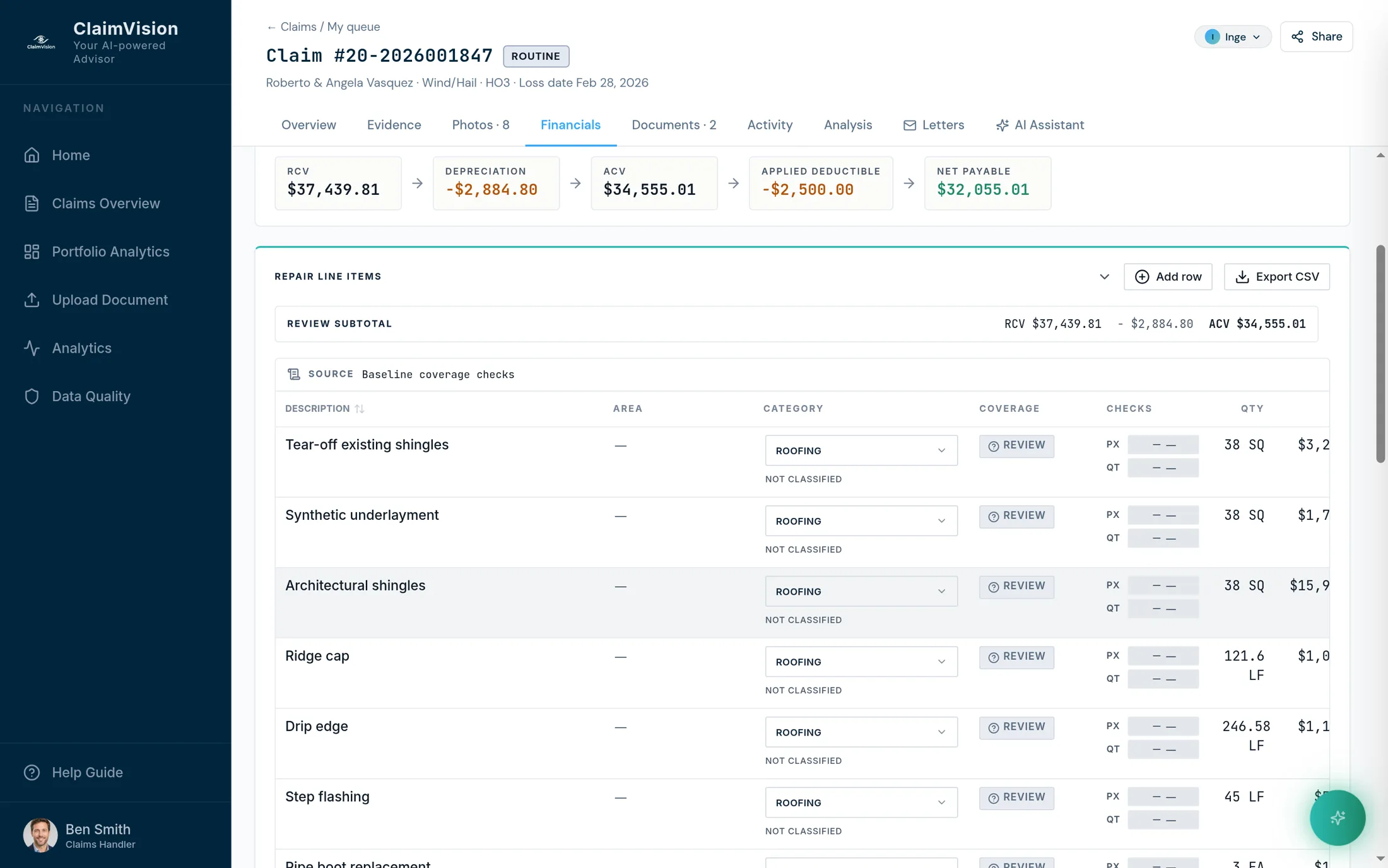
The anatomy of a leak
Five places money leaves a property claim.
None is a large error. All are in the documents, waiting to be read.
| What it looks like on the file | With every page read first | |
|---|---|---|
| Missed exclusions and limitations | A roof surfacing endorsement that moves settlement to ACV. A cosmetic-damage exclusion. Both in the policy, neither reached before payment. | Every provision checked on every claim. The ones that bite are shown with their clause. |
| Limits and deductibles not applied | A wind and hail percentage deductible computed on the loss instead of the dwelling limit. | The limit or deductible that governs each line is applied, and named. |
| Arithmetic that does not reconcile | Depreciation on the wrong lines. Figures that drifted between estimate and statement of loss. | Reconciled line by line, exactly, or flagged for a person. |
| Supplements without a second look | The estimate got scrutiny. The supplement, three weeks later, got trust. | The same coverage check and reconciliation as the original. |
| Recovery never pursued | Subrogation against the contractor whose work caused the loss. | Surfaced as findings when the documents support them. |
The check behind the first two rows is the same policy coverage checking that runs on every claim, whoever holds the file.
Closing the gap
Why does reading everything close the gap?
Because claims leakage starts as a reading problem. Under time pressure, good adjusters read what they must and trust the rest. The busier the week, the wider the gap.
ClaimVision reads every page of every claim before your team opens the file, the fortieth on Friday the same as the first on Monday. Each finding arrives with its clause and its dollar impact. The adjuster decides, and every override is kept in the AI claims audit trail.
The same reading takes the waiting days out of the file, so closing the gap also helps you reduce claims cycle time inside the prompt-payment clock.
What we can show today: a full day's reconciliation work on a real large-loss claim, done exactly, in under a minute.
FAQ
Questions buyers ask
What is claims leakage in property insurance?
Claims leakage is the gap between what the policy says a carrier owed and what it actually paid. In property claims it usually comes from missed exclusions, limits and deductibles applied wrongly, figures that do not reconcile, and recoveries nobody pursued. It is rarely one large error. It is many small ones.
How do insurers reduce claims leakage?
Insurers reduce claims leakage by making sure every page of the file is read and every figure reconciles before payment goes out. File reviews and audits find leakage after the money has left. ClaimVision reads every page of every claim first and shows each finding with its clause and dollar impact, so the adjuster can act before payment.
How much claims leakage will ClaimVision recover for us?
We will not invent that number for you, and you should not trust anyone who does. It depends on your book, your policy forms and your team. What we can show is a full day's reconciliation work on a real large-loss claim, done exactly, in under a minute. Model the rest on your own assumptions in the claims AI value calculator.
Does ClaimVision decide whether a claim is paid?
No. ClaimVision finds the exclusions, limits and reconciliation errors and shows where each one came from. Your adjuster makes the decision, and every recommendation and every override is kept in the audit trail.