How does ClaimVision check coverage?

ClaimVision's policy coverage checking reads the whole policy together with the claim, and hands your adjuster each finding with the clause behind it and its dollar impact. The calls that need judgement are put in front of a person, never decided quietly.

app.claimvision.ai/claims/example
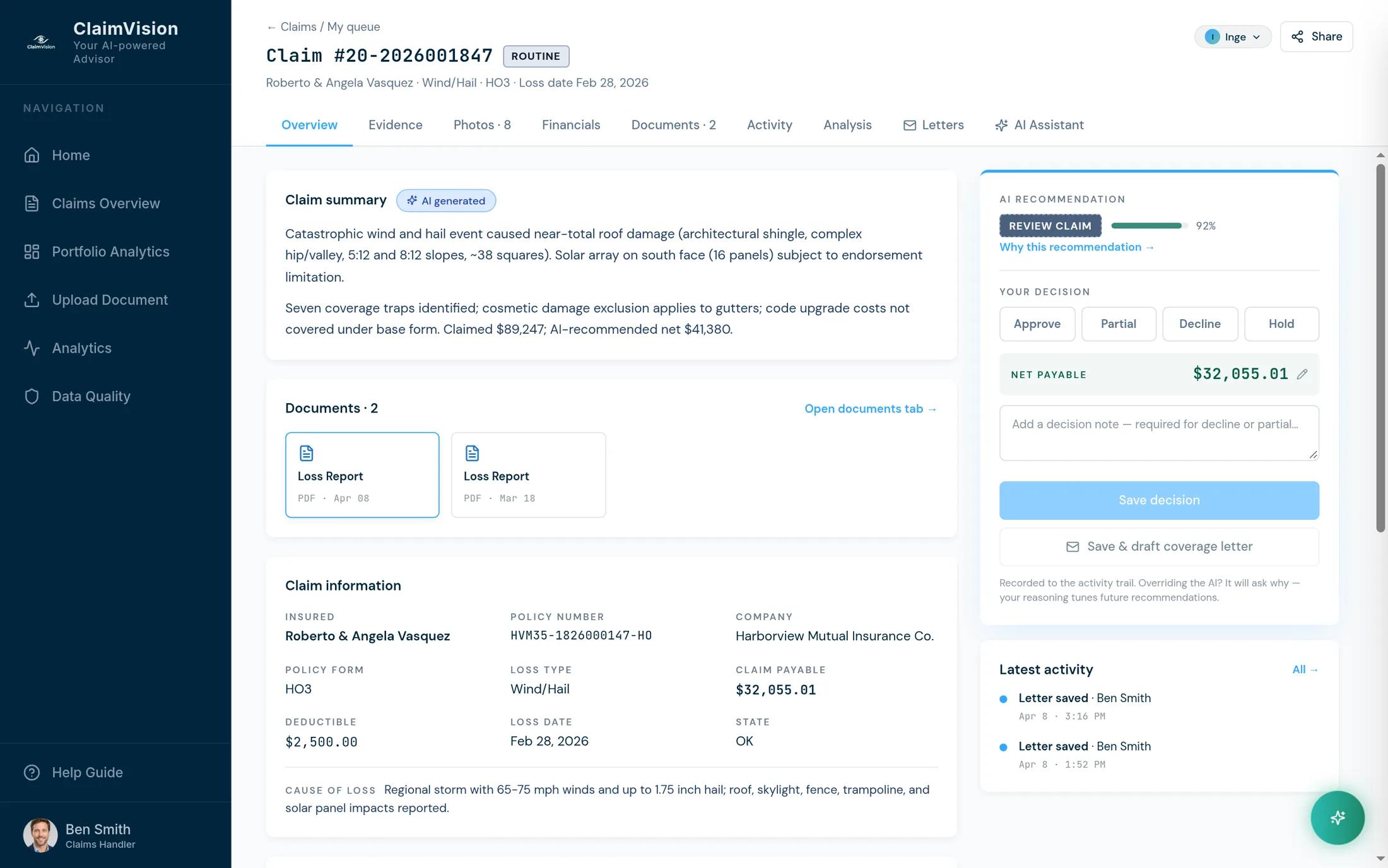
The ClaimVision claim overview for the example wind and hail claim, showing the result of policy coverage checking: the AI recommendation, the coverage traps found and the adjuster's decision buttons.
On the example claim, seven coverage traps surface beside the net payable, and the decision buttons keep the adjuster in charge.

What your adjuster gets from the coverage check

The fine print, read together

An endorsement isn't extra reading. It can rewrite the promise underneath it. ClaimVision reads the policy and everything attached to it as one document, and says in plain language what it means for this claim.

The clause and the dollar impact

Every finding names the clause it rests on, cited to its page, and what it is worth on this claim. Your adjuster can put a finger on it, and so can a supervisor.

Judgement calls, in front of a person

When the language can be read more than one way, ClaimVision doesn't pick silently. It sets out the options with the dollar consequence of each, and the adjuster rules.

Coverage mistakes are rarely knowledge failures. They are pressure failures: the expensive misses live in the reading that got skipped on a busy Friday. ClaimVision gives every claim the same careful check, so the adjuster starts exactly where the problem is, with the evidence already assembled. It is the coverage half of AI property claims review, and the same answers are there to question in the ask your claims data.

Why it matters

What each part of the check is worth, to the adjuster and to the carrier.

The fine print, read together

For the adjuster

No endorsement surprises after the letter has gone out. They start from what the policy actually says about this loss.

For the carrier

Each payment rests on the whole policy, so less money goes out on the wrong basis. See claims leakage.

The clause and the dollar impact

For the adjuster

The decision can be explained to the policyholder, the supervisor or a public adjuster with the page in hand, in one sentence.

For the carrier

Decisions that hold up in file review, in a complaint or in court, because the reasoning is written down at the time it was made.

Judgement calls, in front of a person

For the adjuster

They stay in charge. Nothing is decided quietly on their behalf, and an override is recorded with their reasoning, not held against them.

For the carrier

Ambiguous language is handled on the record, which is what regulators and bad-faith reviews look for. See the AI claims audit trail.

The same check on every claim

For the adjuster

A busy Friday no longer decides how carefully a file is read. The fortieth claim gets the same check as the first.

For the carrier

Consistent handling across tenure, workload and storm weeks, so a new adjuster's file is read as carefully as a veteran's.

Coverage on a busy Friday vs with ClaimVision

On every claimUnder time pressureWith ClaimVision
The policyThe declarations and the familiar sections, as time allows.Every page, with everything attached to it, read together.
A limitation that changes the payoutFound if someone had time to look.Flagged with its clause and its dollar impact on this claim.
Language that reads two waysDecided in the moment, often without a note.Put in front of the adjuster with the options and what each one costs.
The reasoning afterwardsWhatever made it into the notes.Kept in the audit trail, with any override and the reason for it.

If the adjuster overrules ClaimVision's reading, the override and any reason they add are kept in the AI claims audit trail. A limitation found before payment is also money that stays where it belongs: see where claims leakage comes from.

FAQ

Questions buyers ask

What is policy coverage checking on a property claim?

Policy coverage checking is confirming what the policy actually promises for this loss before the claim is paid or denied. That means the base policy and everything attached to it, read against the facts of the claim. ClaimVision does that reading on every claim and shows the adjuster each finding with its clause and dollar impact.

How do insurers catch endorsements that change a payout?

By reading every endorsement on every claim, not only the familiar ones. Misses usually come from time pressure, not from a lack of knowledge. ClaimVision reads the whole policy before the file is opened and flags any limitation with its clause and its dollar impact on the claim.

Does ClaimVision make the coverage decision?

No, the adjuster decides. ClaimVision brings the findings, the clause and the dollar impact, and where language can be read more than one way it sets out the options and leaves the call to a person. Any override is kept in the audit trail, with the adjuster's reason when they give one.

How does coverage checking reduce claims leakage?

It finds the limitation before the payment goes out. Leakage often comes from a clause nobody had time to read or a payment made on the wrong basis. When every claim gets the same careful check, those findings surface with the dollar figure attached, while there is still time to act on them.
See it on a full claim.

Six screens, one example claim, from upload to the decision letter.