How do you reduce property claims cycle time?
You reduce claims cycle time by taking the waiting out of the file: the days it sits before anyone has read it, and the days between a decision and its letter. ClaimVision does the reading before the adjuster opens the file, so those days come off the clock, inside the state prompt-payment and fair-claims-practices deadlines.
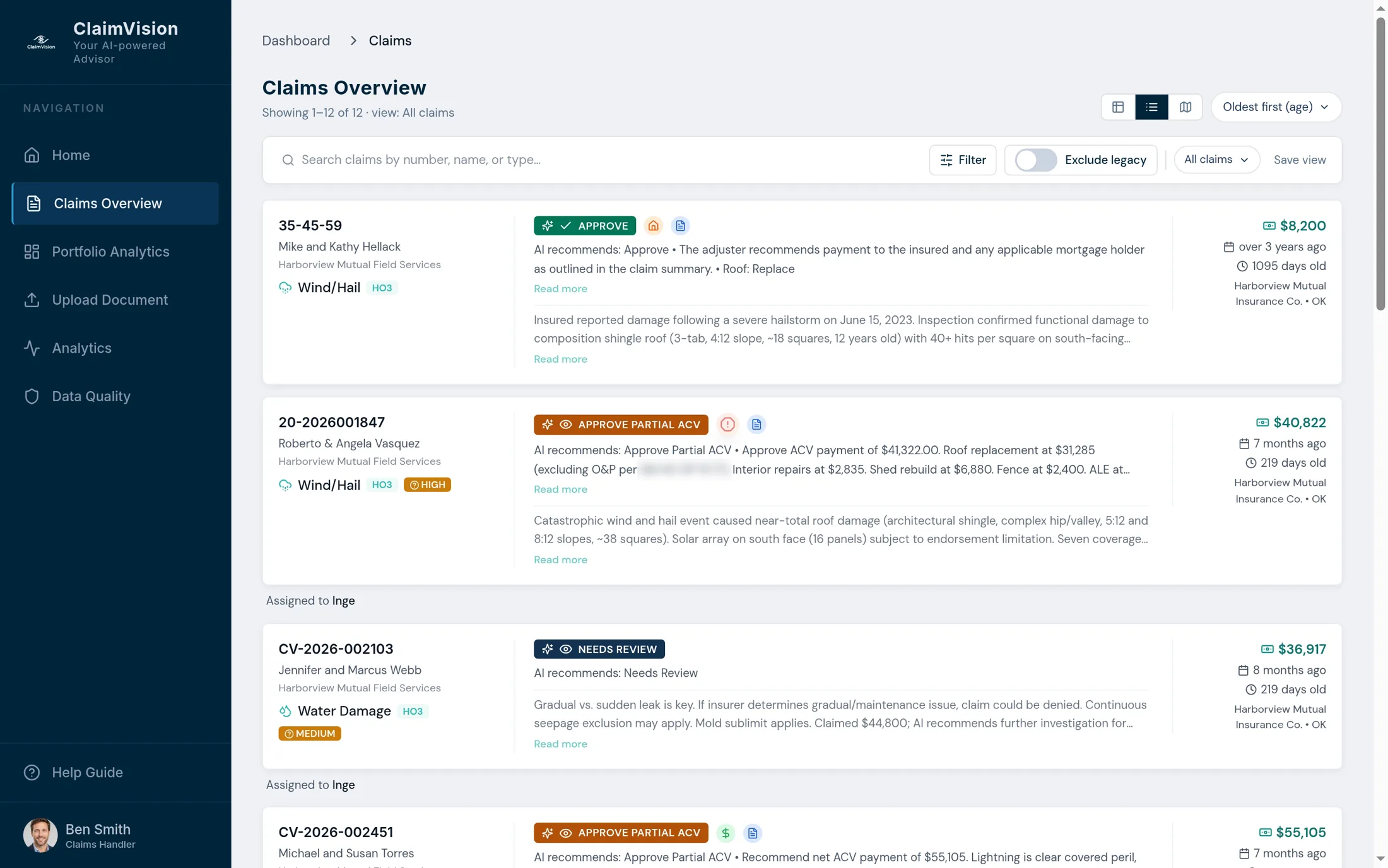
Where the days go
Most of cycle time is waiting, not deciding.
A property claim spends far more of its life waiting to be read than being decided. Each stage below is a wait the reading removes. The decision itself still takes the time it deserves.
| Stage | What the file waits for today | With ClaimVision |
|---|---|---|
| First notice of loss to first look | A place in the queue. Nothing is known until someone opens the file. | The file is read on arrival and shows what it needs from a person. |
| Investigation | Someone with time to read the adjuster report, the estimate and the policy together. | Findings are waiting, each with the clause it rests on and its dollar impact. |
| Decision | The judgement calls, buried somewhere in several hundred pages. | The calls arrive isolated, with the evidence beside them. The adjuster decides. |
| Letter | A letter written by hand, then checked against the file. | The letter drafts itself from the decision, on your template with the claim's details filled in: review it, edit it, download it. |
| Complaint or dispute | Reconstructing why the decision was made, weeks later. | The AI claims audit trail already holds why. |
A slow claim is the most reliable path to a complaint, and complaints escalate: to the regulator, to a public adjuster, to counsel. Every stage costs more than the one before it, and every stage was bought with waiting.
The regulatory clock
What deadlines does the regulatory clock set?
Every US state sets deadlines to acknowledge a claim, investigate it, accept or deny it, and pay it. The counts differ by state, start from different triggers (notice of claim, proof of loss, receipt of requested items) and change often. A few examples, read from the primary text:
| Rule | Acknowledge and investigate | Decide and pay | Source |
|---|---|---|---|
| NAIC Model Regulation 902 (binds only states that adopt it) | Acknowledge within 15 days of notice. | Accept or deny within 21 days of proof of loss, or explain the delay in writing every 45 days; pay within 30 days of affirming liability. | NAIC model PDF checked 4 Oct 2026 |
| Texas Insurance Code ch. 542 | By day 15 after notice: acknowledge, begin investigating, request what is needed. | Accept or reject by the 15th business day after receiving all items; pay by the 5th business day after accepting. A declared weather catastrophe adds 15 days. | Texas statutes checked 4 Oct 2026 |
| Florida Statutes § 627.70131 (residential) | Acknowledge within 7 days; begin investigating within 7 days of proof of loss. | Pay or deny within 60 days of notice. An emergency order may add at most 30 days. | Florida statutes checked 4 Oct 2026 |
| Louisiana R.S. 22:1892 | Begin adjusting within 14 days of notice; 30 days in a declared catastrophe. | Pay within 30 days of satisfactory proof of loss. | Louisiana law checked 4 Oct 2026 |
Summaries for illustration, not legal advice. Units differ (calendar days and business days) and so do the triggers; read each statute for exceptions. Oklahoma, Georgia and other states set their own clocks in their own codes.
The clock matters most the week a storm lands. The volume can multiply overnight; the deadlines barely move. That is the week a carrier finds out whether its catastrophe claims surge plan holds, and the week the reading has to be done before the file is opened.
For the family who filed it
The moment a family needs its insurer most is the moment the process is slowest.
Every day taken off the cycle goes back to the people waiting on it: a call answered with facts, a decision explained with the actual clause, a recoverable-depreciation deadline flagged before it quietly passes.
What we can show today: a full day's reconciliation work on a real large-loss claim, done exactly, in under a minute.


FAQ
Questions about claims cycle time
How do you reduce claims cycle time on property claims?
Take the waiting out of the file. Most of a property claim's cycle time is days a file spends unread, waiting for someone to work through the report, the estimate and the policy, and days between a decision and its letter. When the reading is done before the adjuster opens the file and the letter drafts from the decision, those days come off the clock.
What is the average cycle time for a US homeowners claim?
J.D. Power's 2026 U.S. Property Claims Satisfaction Study reports an average of 40.7 days to final payment on homeowners claims. Catastrophe claims usually run longer, because the volume arrives in the same week the staffing does not change.
What are prompt payment laws for property insurance claims?
They are state rules that set deadlines to acknowledge a claim, investigate it, accept or deny it, and pay it. The counts differ by state and change often: Florida, for example, requires residential property insurers to pay or deny within 60 days of notice, while Texas counts some deadlines in business days from receipt of the items it requested. Check each state's current statute.
Does AI shorten claims cycle time by deciding claims for the adjuster?
Not with ClaimVision. The reading goes to the machine; the judgement stays with your people. ClaimVision shortens the wait before a decision and after it, and the adjuster still makes it.
Does the prompt-payment clock stop during a catastrophe?
Rarely, and never for long. Some states allow limited extensions after a declared catastrophe, such as fifteen extra days in Texas or up to thirty more in Florida by regulator order, but the volume rises far faster than the deadlines move.