AI property claims review: how ClaimVision reads a claim
ClaimVision's AI property claims review reads every page of a claim (the adjuster and inspection reports, the estimate, the policy and every endorsement, proof of loss and the photos) before your team opens the file, and hands back each finding with its source page, its policy clause and its dollar impact. The reading goes to the machine. The judgement stays with your people.
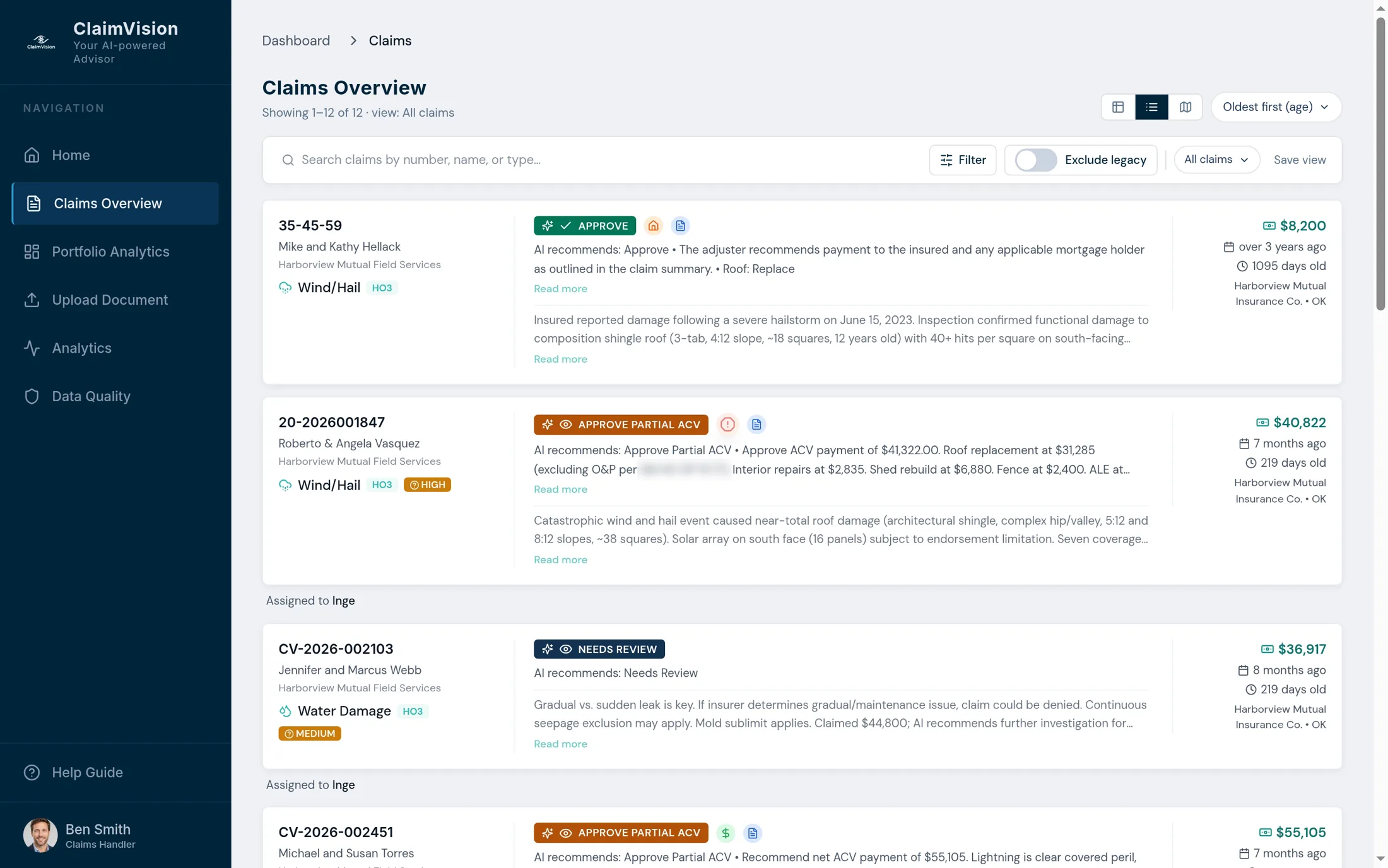
The reading
The whole file, read together.
What lands on your desk, on every claim
-
Every page, read before the file is opened
The loss report, the photos, the estimate down to its last line, the policy and everything attached to it. Your claims manager gets a one-page view of a several-hundred-page claim, before they've poured the coffee.
-
The same careful check, every time
The first claim on a quiet Monday and the fortieth on a brutal Friday get the same check. What needs a person's judgement arrives flagged and waiting. More on policy coverage checking.
-
Every finding with a number attached
Not "here is some relevant policy language." Here is what applies, why, and what it is worth on this claim, with the figures held steady from finding to settlement. What we can show today: a full day's reconciliation work on a real large-loss claim, done exactly, in under a minute.
-
A record that can answer for itself
Every recommendation, every source cited and every human override is kept, never overwritten. The file can answer for itself in front of a supervisor, a regulator or a reinsurer. See the AI claims audit trail.
When the reading is done before the first touch, waiting days come off the file. That is how you reduce claims cycle time inside the prompt-payment clock. And you do not need to replace Guidewire ClaimCenter, Duck Creek or a system built in-house: ClaimVision is an AI layer on a core claims system.
ClaimVision vs manual review: what actually changes?
| On every claim | Manual review alone | With ClaimVision |
|---|---|---|
| What gets read | What the minutes allow: the summary, the totals, the familiar endorsements. | Every page of every document, before the adjuster opens the file. |
| Coverage check | Experience-driven; consistency varies with workload, tenure and the day. | The same careful check on every claim, every time, then human judgement on what it surfaces. |
| Estimate reconciliation | Spot-checked; a long estimate takes the better part of a day to verify by hand. | Line by line and exact, or flagged where it does not reconcile. |
| The record | Whatever made it into the notes. | Every finding, source, confidence level and override, kept automatically. |
| Where the hours go | Reading, locating, re-keying, reconciling. | Judgement, conversations with families, and the claims that genuinely need a person. |
The person stays in charge either way. The difference is what they're in charge of.
Beyond the coverage findings
Document extraction, photos, questions and recoveries, from the same reading.
Because every page is read, the same reading answers more than the coverage question. This is claims document AI that keeps the evidence attached.
Every page becomes structured data.
Adjuster and inspection reports, estimates, the policy and every endorsement, proof of loss and photos, turned into data your team can question.
Photo analysisPhotos read with the file.
ClaimVision looks at every photo in the file, reads its caption and label, and checks whether the adjuster's report matches what the photos show.
AI document assistantAsk the claim's documents.
A built-in assistant answers questions about the claim's documents, including documents that have not been through full processing yet.
Subrogation and salvageRecoveries checked on every claim.
Every file is checked for subrogation and salvage, and for negligence that could affect what is owed.
Portfolio visibilityClaims, payouts and loss types across the book.
A portfolio view for claims leaders, with plain-language insights.
Audit trailEvery finding on record.
Each finding, its source, the recommendation and the human decision, kept and never overwritten.
FAQ
Questions buyers ask
What is AI property claims review?
AI property claims review means software reads every document in a property claim and returns findings for a person to decide. ClaimVision reads the loss report, the photos, the estimate and the policy before your team opens the file. Each finding carries its source and its dollar impact, and the decision stays with the adjuster.
Does AI claims review replace adjusters?
No. The reading goes to the machine. The judgement stays with your people. Adjusters spend their hours on the calls that need a person instead of on locating, re-keying and reconciling.
What documents does ClaimVision read on a property claim?
Every page of the file: the loss report, the inspection report, the photos, the estimate down to its last line, and the policy with everything attached to it. They are read together, so a line in the estimate can point to the clause that limits it.
How does AI claims review shorten claims cycle time?
It removes the wait for someone to read the file. With ClaimVision the file is read before an adjuster opens it, so the first touch starts with the findings, not the paperwork. That takes waiting days off cycle time, inside the state prompt-payment clock.
Can every AI finding be traced back to the policy?
Yes. Each finding names the document and page it came from and the clause that decides it. Every recommendation and every human override is kept in the record, so the file can answer for itself in a review.