There is no single best AI claims tool. There is a best tool for each job: settling simple claims without a handler, estimating damage from photos, catching fraud, getting first notice into the system, watching casualty severity, helping inside the core system, and reading the property file before anyone opens it.
When we talk to claims leaders about AI, the useful question is rarely "which tool is best?" It is "which tool is best for the problem costing us days right now?" So this guide sorts the tools by the job they do, not by a score.
One of the tools is ours, so read this as our view. Every statement about another company comes from that company's own public page, linked, and checked on 13 October 2026. Where another product is the stronger fit, we say so.
- Straight-through processing
- Photo and damage estimating
- Fraud detection
- Document intake
- Casualty claims analytics
- AI inside the core system
- Reading the property file
- All of them, side by side
- How to choose
Straight-through processing
Picture a desk with a pile of simple claims and one large loss that needs real attention. The simple ones still take the morning, because each has to be opened, checked and keyed before anyone can say it is fine. Straight-through processing is the promise that the routine claims move on their own, while the person stays with the file that cannot. Good looks like a clear rule for what may go through, a person on the exceptions, and a record of why. The longer definition: straight-through processing.
Sprout.ai
Sprout.ai's platform page describes five modules: document processing, coding and enrichment, policy coverage checking, fraud flagging and decisioning. It says the aim is to auto-adjudicate the majority of claims, with straight-through processing wherever possible, and to give handlers insights and recommendations on complex cases. It names core systems including Guidewire, Duck Creek, Majesco and Sapiens. Sprout.ai platform page
Its solution page lists seven sectors, from health, life and disability to motor, travel and pet. Home and property is one of them. Sprout.ai solution page
Where Sprout.ai is stronger. You write several lines and want simple claims to settle without a handler. ClaimVision does not settle claims on its own, so if that is the goal, Sprout.ai fits better. Ask to see it on a US homeowners file. More in ClaimVision vs Sprout.ai.
Photo and damage estimating
After a hailstorm, the first thing a family sends is a photo of the damage. The adjuster wants to know quickly whether it is a repair or a bigger conversation. That is a different job from reading the policy. Good looks like a fast, honest read of the damage, with a person still able to disagree. The two best-known names in this job publish it for vehicles.
Tractable
Tractable's insurer page describes AI that evaluates vehicle collision damage from photos, from minor scratches to a total loss: classifying a claim at first notice as a total loss, repairable or a cash settlement, verifying repair estimates, and reviewing claims for consistency and fraud. Tractable insurers page
In August 2025, Tractable announced an agreement to sell its Japan property business to NTT-ME, part of the NTT East Group, to focus on the automotive side. Tractable announcement
Where Tractable is stronger. Photo triage and repair estimating for auto. ClaimVision reads photos alongside the rest of a property file; it does not write a line-level repair estimate from an image. More in ClaimVision vs Tractable.
CCC Intelligent Solutions
CCC's estimating page describes line-level estimates generated from vehicle damage photos for qualified repairable vehicles, using the carrier's own rules. The carrier can pass a preliminary estimate to an appraiser or, where configured, release it for automatic approval. CCC claims estimating page
Where CCC is stronger. Writing and approving auto repair estimates from photos under your rules, with an appraiser able to finish the file. That is a real job, and not the one we do.
Fraud detection
Every claims leader has a story about the one that got away: a claim that looked routine until someone noticed the photos did not quite add up. Fraud is not only a cost line. It is part of why honest families wait, because every file gets treated with a little suspicion. The tools below do not replace a good SIU team's instinct. The best of them help that team spend its time on the files that deserve it. The term, defined: fraud signal.
Shift Technology
Shift's homepage describes AI agents for insurers across coverage and liability, fraud and risk, subrogation and injury, plus an Insurance Data Network. Shift Technology homepage Its fraud page describes agents that detect and prioritize suspicious claims, build an investigation plan and take on case tasks, drawing on cross-carrier data through that network. Shift fraud and risk page
Its coverage and liability page asks a different question from ours: duties owed and breached, details from police reports and statements, and a liability estimate that updates as documents arrive, with agents working alongside human experts. Shift coverage and liability page
Where Shift is stronger. Fraud investigation, and liability from incident documents. Many property carriers would run that beside a file reader rather than instead of one. More in ClaimVision vs Shift Technology.
FRISS
FRISS's claims page says it tells you which claims to trust and which need an expert fraud review, so honest claims can take a fast track, including straight-through processing. Claims are scored in real time, and the page names Guidewire, Sapiens and Duck Creek among the core systems it works with. FRISS fraud detection at claims
Where FRISS is stronger. Scoring every claim for fraud from inside the core system, and fast-tracking the ones that pass. ClaimVision does not score claims for fraud.
Document intake and extraction
Monday morning, the inbox is the claim: notices, ACORD forms, photos and loss runs, all waiting for someone to key them in before anyone can think. That keying is where files sit and where small mistakes creep in. Good looks like the fields landing cleanly, the odd ones flagged, and a person checking the exceptions. Four companies publish a version of that front door. It is how a claim gets opened, which is a different job from reading a long property file once it exists. The term, defined: first notice of loss.
Hyperscience
Hyperscience's claims page walks through an email and its attachments being classified, fields extracted, a case opened from the policy number and business rules applied, with a person in the loop. Its worked example is a travel claim. Hyperscience claims processing Its insurance page describes use across life, health, property, casualty and reinsurance, with pre-built models for ACORD forms. Hyperscience insurance page
Where Hyperscience is stronger. Messy inbound documents, standard forms included, turned into clean fields across several lines. If the wait is data entry at intake, start there, and ask to see a property claim.
Indico Data
Indico's claims page describes agents that take in PDFs, emails, images and scanned forms, fill and check the fields, and flag what is missing or in conflict, with recommendations tied to source evidence and connectors for tools such as Outlook, SharePoint and Guidewire. Indico claims FNOL page Its property and casualty page applies the same idea to loss runs, ACORD forms and first notice, organizing the documents into a claim file. Indico P&C page
Where Indico is stronger. The front door of a P&C operation, when first notice arrives as an unstructured package. ClaimVision starts once there is a property file to read.
FurtherAI
FurtherAI's page for claims professionals describes intake that runs from first notice to an open claim, coverage gaps caught at intake, loss runs turned into tables, and policy summaries with each line anchored to the source wording, with a person on the complex files. FurtherAI claims page
Where FurtherAI is stronger. Specialty and commercial teams that want intake, loss runs and cited policy summaries in one workspace. Ask for a homeowners example if that is your book.
V7 Go
V7's claims page describes document agents from first notice through cost control, reading FNOL forms, adjuster notes, policy wordings, repair estimates and invoices, citing every extracted point to its source and cross-checking it against policy terms and exclusions. V7 Go claims management Its claims agent page describes reading a whole submission packet, running an initial coverage check, triaging the claim and flagging fraud indicators. V7 Go claims agent
Where V7 Go is stronger. One configurable layer across many document workflows, including packets that mix medical bills, police reports and estimates. Citing each field to its page is the right bar, and they publish it.
Casualty claims analytics
On a casualty book, the fear is the claim that looks ordinary in week one and enormous in month eight. The people watching it want an early signal on severity, treatment and litigation, with a person still choosing the path.
CLARA Analytics
CLARA's homepage describes its platform as a casualty claims intelligence platform, with products for claim documents and medical records, early triage of potentially costly claims, treatment, attorney-involved claims and fraud referral, across workers' compensation, auto liability and general liability. CLARA Analytics homepage
Where CLARA is stronger. Casualty severity, medical records, treatment and litigation. CLARA uses the words "claims intelligence" too, for a casualty book. Ours is for property, so if your book is workers' compensation or auto liability, start there.
AI inside the core claims system
If your people live in ClaimCenter, the help they will actually use is the help that shows up on that screen. A second login is where good intentions go quiet. Good looks like an answer on the open claim, with the source attached, and the system of record left where it is.
Guidewire ProNavigator
Guidewire describes ProNavigator as an assistant embedded in Guidewire applications. For a claims handler, its page lists policy terms and coverage details on the open claim, help with damage assessment and reserves, claim summaries and less time on notes, with a person in the loop and answers cited back to the source. Guidewire ProNavigator
Where Guidewire is stronger. Your people already work in ClaimCenter and want the assistant on that screen, grounded in your own guidelines. Guidewire owns that workflow. You also do not need to replace Guidewire ClaimCenter to put a property-file reader beside it. More in ClaimVision and Guidewire ClaimCenter.
Reading the property file
The file lands, and it is long: the adjuster's report, the estimate, the policy and its endorsements, the photos. Someone has to read all of it before they can say what the claim is worth. That reading is the wait. Good looks like the reading done before anyone opens the file, every finding linked to the page it came from, and the decision left with a person.
ClaimVision
ClaimVision is an AI claims intelligence platform for US property carriers and TPAs. It turns every page of a claim into structured data before your team opens the file, and lets them question that data with the evidence attached.
Findings come back with the clause and the dollar impact. The adjuster sees a recommendation, can ask the file a question and get the page back, and approves, adjusts or overrides. The audit trail keeps every recommendation and every override, through to the decision letter. What we can show today: a full day's reconciliation work on a real large-loss claim, done exactly, in under a minute.
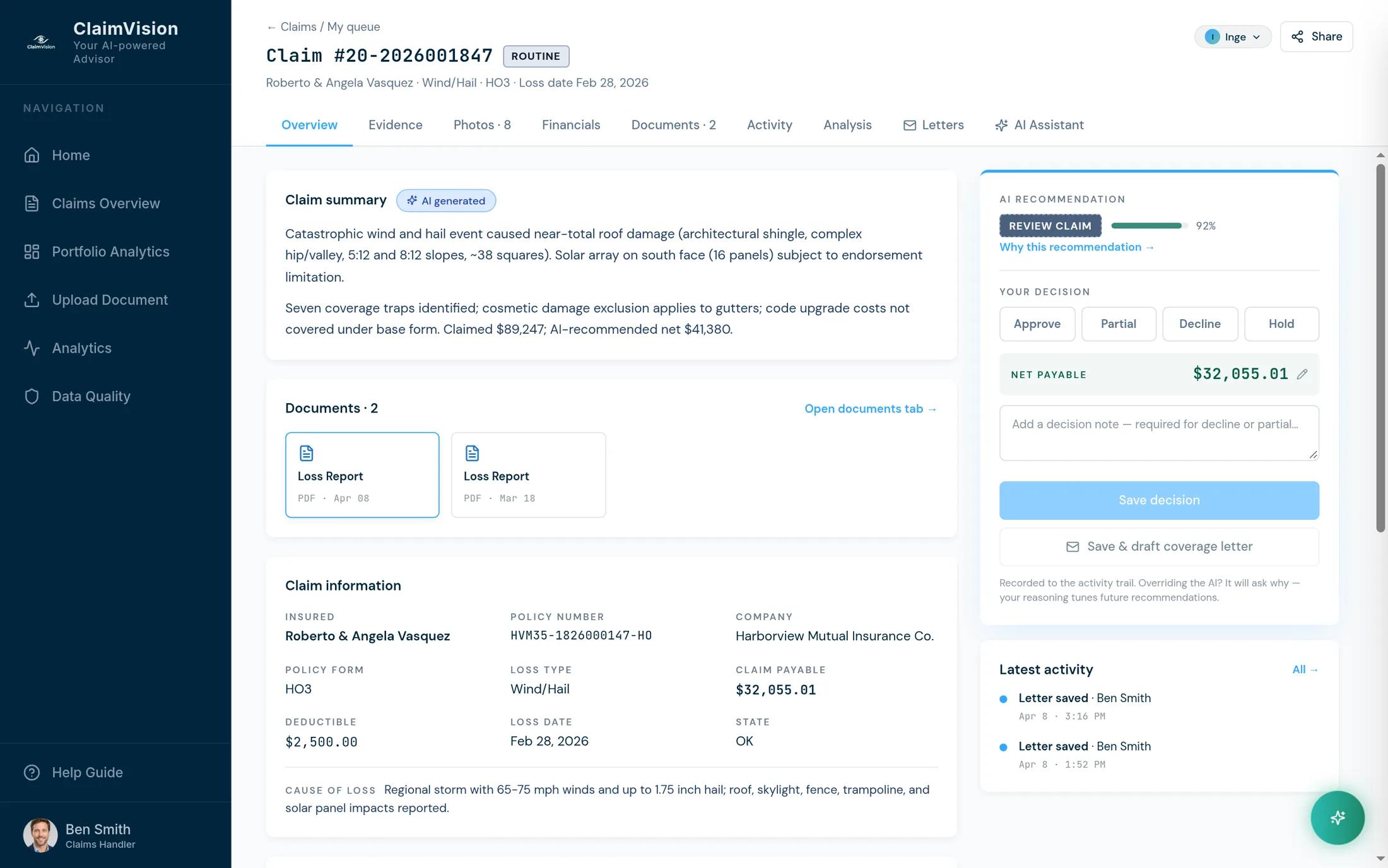
Where ClaimVision fits. You are a US property carrier, or a TPA handling property claims for one. The files are long, and a person still has to rule on every claim. If the job is settling claims without a handler, a vehicle estimate from photos, fraud scoring, intake, casualty severity or help inside ClaimCenter, one of the tools above is the stronger fit. See one example claim walked through, or start with what AI claims intelligence means.
All of them, side by side
A meeting sometimes needs a table. This is not a ranking. Each row describes the job on the vendor's own page and the situation where it is the stronger fit.
| Tool | The job on its own pages | Stronger when |
|---|---|---|
| Sprout.ai | Multi-line claims automation, straight-through where possible | You want simple claims settled without a handler across several lines |
| Tractable | Vehicle damage assessment from photos | The bottleneck is an auto estimate from photos |
| CCC | Line-level auto repair estimates from photos, under carrier rules | Appraisers need AI-built auto estimates |
| Shift Technology | Fraud and investigation agents, plus liability from incident documents | You need an SIU stack or a liability estimate |
| FRISS | Real-time fraud scoring, with a fast track for trusted claims | You want every claim scored for fraud in the core system |
| Hyperscience | Classify and extract inbound documents, with a person on exceptions | Intake is rekeying, across several lines |
| Indico Data | First notice intake for P&C into a claim file | First notice arrives as an unstructured package |
| FurtherAI | Intake, loss runs and cited policy summaries | Specialty or commercial intake is the constraint |
| V7 Go | Configurable document agents that cite each extracted field | You want one document layer across many workflows |
| CLARA Analytics | Casualty claims: medical records, severity, treatment, litigation | The book is casualty or workers' compensation |
| Guidewire ProNavigator | An assistant inside Guidewire, on the open claim, with cited answers | Your people live in ClaimCenter and want help there |
| ClaimVision | Reads the whole US property file before the adjuster opens it | The wait is the reading, and a person decides every claim |
How to choose
Bring the job into the meeting, not the logo. You know your bottleneck better than any vendor does.
- Name the bottleneck in one sentence. Unread property files, auto photo estimates, fraud referrals, first notice data entry, casualty severity, or help inside ClaimCenter. Those are different purchases.
- Check the line of business on their own page. A page built around vehicle photos, medical bills or a travel invoice is a clue. Ask to see the same job on a US homeowners file.
- Decide who may settle. If simple claims should move without a handler, look at the straight-through tools. If a licensed adjuster must decide every property claim, look at a reader.
- Keep the system of record. Ask what is read, what is written back and what would have to move. A vendor naming Guidewire is not, by itself, an integration you can switch on. Ask how documents would move, including when you ask us.
- Test on closed files you already decided. It is the fairest test there is. Ask every vendor for it, on your files.
- Plan on a stack. Fraud, photos, intake and file reading solve different delays. The expensive mistake is paying two vendors for the same job.
On security, ask each vendor to put it in their own words. Ours: ClaimVision runs on Microsoft Azure and is built to SOC 2 principles. We are working towards a SOC 2 Type 2 audit; we are not yet certified. The longer version is on our security page.
We opened every vendor page linked here on 13 October 2026. If a vendor changes its page, the sentence about it should change too; tell us and we will update this guide.
Whichever tools you choose, the reading can go to the machine. The judgement stays with your people.
Bring a closed claim you already know the answer to, and we will walk it together. Thirty minutes is enough.
Book a demo