In claims automation vs claims intelligence, automation moves routine work through the process without a person touching it, and intelligence reads the whole claim file so the person who decides has the evidence in front of them; a property carrier needs the first for volume and the second for every claim that still needs a judgement.
They are not rivals. They do different jobs, and the useful question is which job is costing you more days right now.
What each term means
Claims automation is software that performs process steps by rule. It captures first notice of loss, routes the claim, assigns it, sends status updates and, for claims that meet set criteria, pays them without a handler. It works on fields: the claim type, the amount, the policy number, the date.
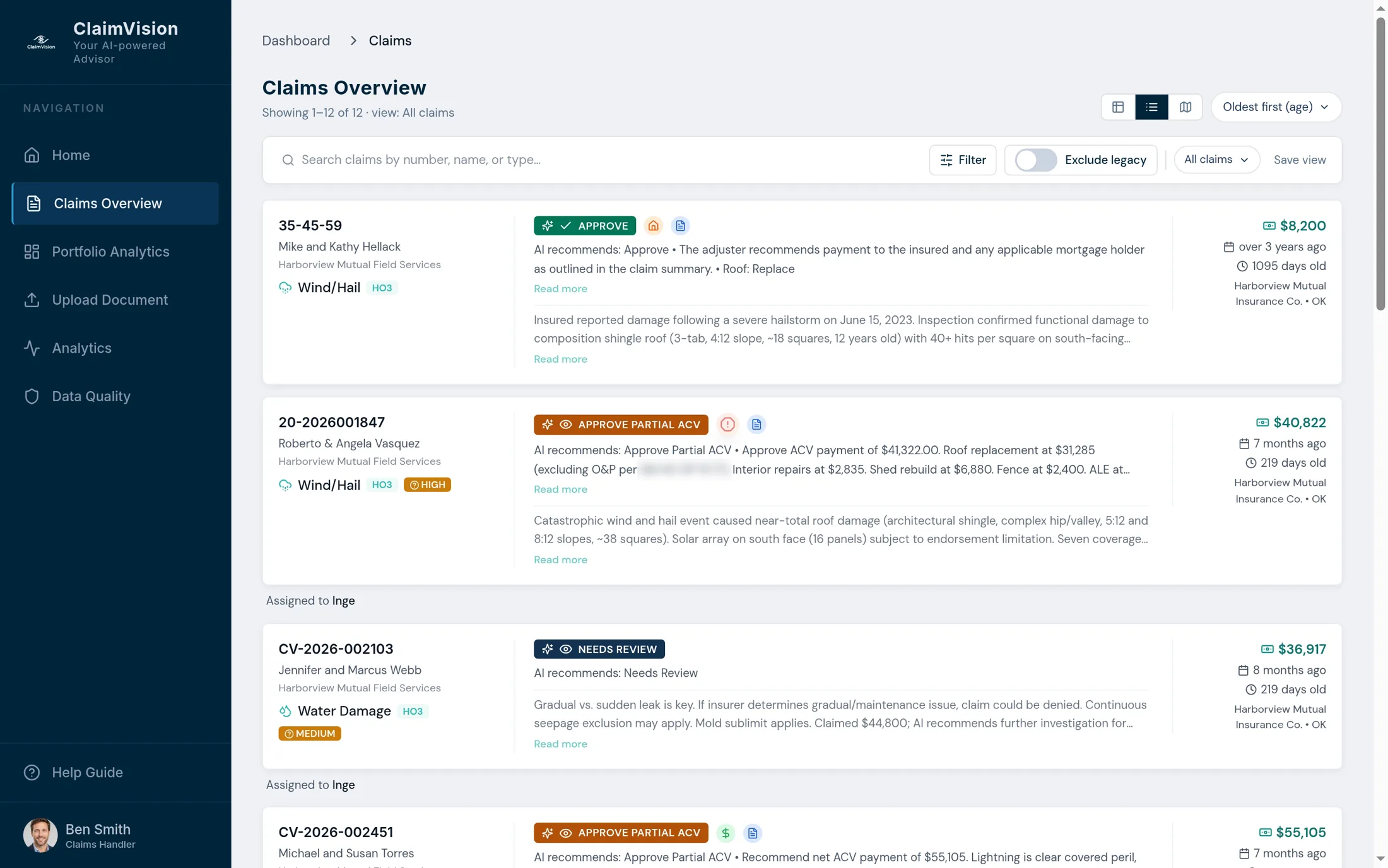
Claims intelligence is software that reads the claim's documents and hands back findings. It works on pages: the adjuster's report, the estimate, the policy and every endorsement, the photos. It tells the person on the file which provision applies, what it is worth on this claim and which figures do not reconcile, with the evidence attached. The longer definition: AI claims intelligence.
What automation does well
Automation earns its place on work that follows a pattern, and a claims operation has a lot of that.
- FNOL intake. A clean first notice, captured from a portal, an app or a call script, means the claim starts with the right policy, the right contact and the right loss date.
- Routing and assignment. Sending a claim to the right desk by peril, severity and location takes seconds when rules do it, and a morning when it waits in a shared inbox.
- Straight-through processing. Low-value claims with clear coverage can be paid without a handler. That frees experienced people for the files that need them.
The opportunity is real. McKinsey's study Claims 2030: A talent strategy for the future of insurance claims (2020) estimated that more than half of current claims activities could be automated by 2030. A carrier still rekeying first notice data by hand has easy days to win back.
Where automation stops
Automation needs the answer to exist as a field. On a property claim, the hardest answers are still sentences.
- The judgement. A rule can check that a claim sits under a threshold. Whether the damage in the photos matches the cause of loss in the report is a reading question first and a judgement call second.
- The fine print. The answer often sits in an endorsement that changes what another provision means. Until someone reads them together, there is no field for a rule to fire on.
- The defence of the decision. When a family, a public adjuster or a regulator asks why, "the rule passed it" is a thin reply. A decision needs the clause, the reasoning and the person who ruled. That is what an AI claims audit trail is for.
None of this is a flaw in automation. It is the edge of its job. Claims that cross that edge go to a person, and that person still has to read the file. If your team reads every page by hand today, here are the alternatives to manual claims review.
Side by side
| Claims automation | Claims intelligence | |
|---|---|---|
| The question it answers | What happens next to this claim? | What does this claim's file actually say? |
| Works on | Fields: claim type, amount, dates, policy number | Pages: reports, estimates, policies, endorsements, photos |
| Best at | FNOL intake, routing, assignment, straight-through payment of simple claims | Coverage traps, figures that must reconcile, claims a person has to decide |
| Who decides | The rule, for claims inside its criteria | Your adjuster, with the evidence in front of them |
| How you measure it | Touches removed, straight-through rate | Findings, leakage caught, decisions that hold up |
Which a property carrier needs first
Start where your days are lost.
If claims wait in a shared queue before anyone has looked at them, or adjusters rekey first notice data, fix intake and routing first. That work is well understood, and your core claims system may already include some of it.
If intake is tidy but the hours go into claims a person has to decide, automation has already done what it can. Wind and hail with layered endorsements, supplements, disputed scope: those files are slow because of the reading. That is where claims intelligence pays back, and where you reduce claims cycle time on the claims that turn into complaints. J.D. Power's 2026 U.S. Property Claims Satisfaction Study puts the average wait for final payment on a homeowners claim at 40.7 days.
The storm makes the choice sharper. In a catastrophe claims surge, the routine tier grows, and so does the pile of files that need a person.
The two also work together. A claim that has been read in full is a claim you can trust to be routine, so intelligence widens the lane automation runs in. The reading goes to the machine. The judgement stays with your people.
See the reading on a claim you already know the answer to. Thirty minutes, one closed file.
Book a demo