You add an intelligence layer that reads the unstructured claims documents your core system already stores, and you leave the system of record alone. The core keeps the record. Your people keep the decision. The layer does the reading, and shows its work. That holds whether the core is Guidewire ClaimCenter, Duck Creek, Sapiens or something built in-house.
That is the short answer. The rest of this guide explains why it works, what to ask a vendor, and what we have measured so far.
What counts as an unstructured claims document?
An unstructured claims document is any part of the claim file that arrives as pages rather than fields: the adjuster's report, the repair estimate, the policy and its endorsements, the declarations page, the proof of loss, photos and correspondence.
Your core system stores these well. It files them, links them to the claim and keeps them safe. It was never built to read them.
That gap matters because the documents are where the claim is decided. The estimate holds the numbers. The endorsements hold the exceptions. Picture the week after a hailstorm: a claims manager opens a file several hundred pages long, and somewhere in the policy is the sentence that changes the payment. She has minutes, not hours. When nobody can read the estimate and the fine print together, coverage gaps get missed and figures stop reconciling. That is where claims leakage begins.
Three ways carriers try to close the gap
Every carrier already does at least one of these. Most do the first.
| Approach | What happens | The catch |
|---|---|---|
| Read harder | Experienced people read what they can, under pressure | Works on a calm Monday. Strains on the fortieth file on a Friday, and breaks the week a storm lands |
| Replace the core system | Move to a new platform and migrate the data | Quarters to years, with cutover risk on the system of record. The documents still need reading |
| Add an intelligence layer | Software reads every document already in the file and hands back findings | It has to earn its place beside systems you already trust, one claim at a time |
The third route is what AI claims intelligence means in practice: an AI layer on a core claims system, not a new core system. If you are weighing it against tools built to move claims rather than read them, start with claims automation vs claims intelligence.
What a good intelligence layer hands back
Four things, on every claim:
- A one-page view of a file that runs to several hundred pages.
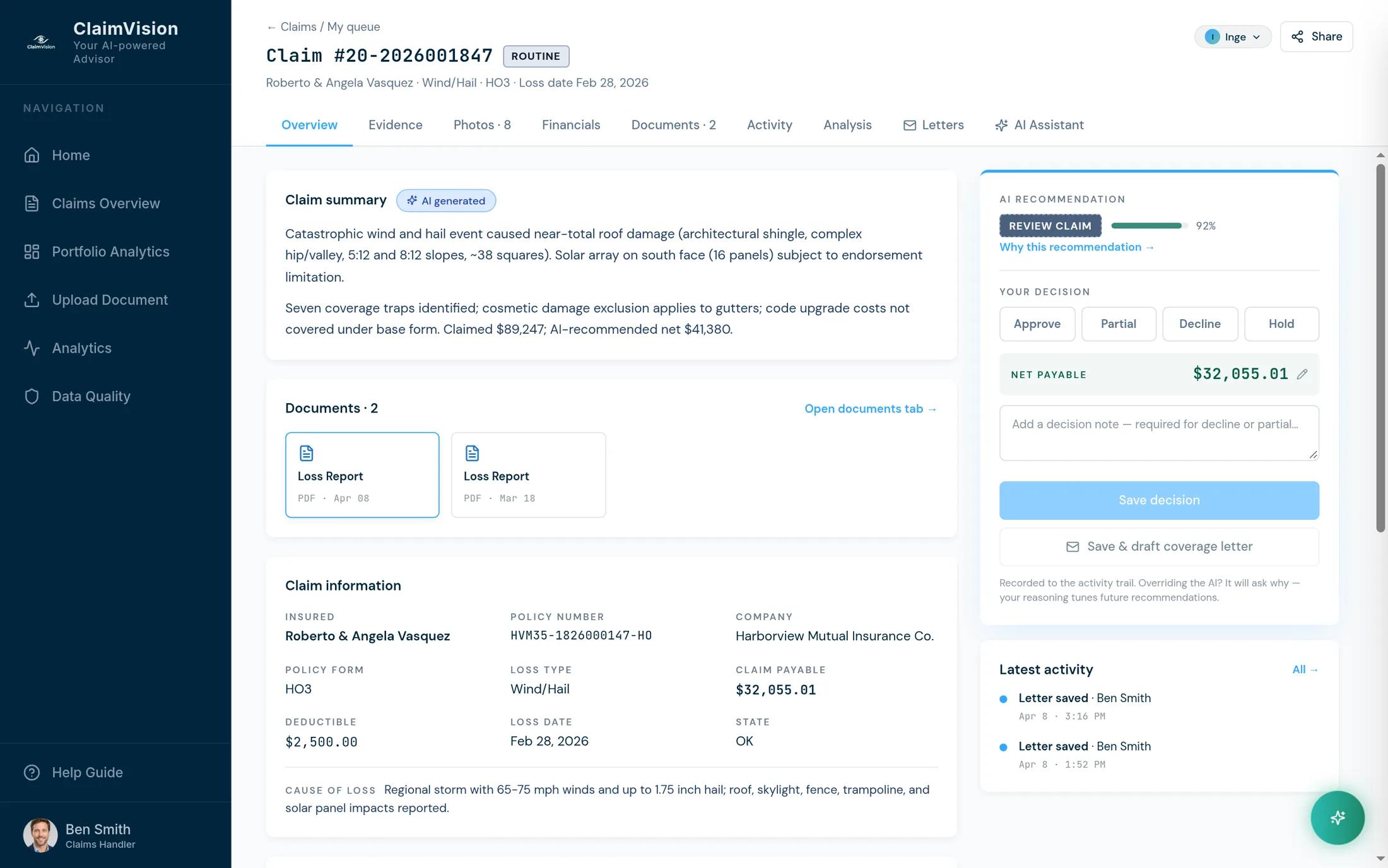
- Findings tied to their source: the specific provision, why it applies, and what it is worth in dollars on this claim.
- Figures that reconcile, so the numbers in the letter match the numbers in the estimate.
- A full AI claims audit trail: every recommendation and every human override preserved, nothing overwritten.
The last one is the one to press on. Insight you cannot defend to a regulator, a reinsurer or a court is only a faster opinion.
None of this moves the claim. The findings sit beside the file your core system already holds, and your adjusters keep working in the system they know.
Five questions to ask any vendor
- Does it read the whole file, including the policy and every endorsement?
- Does each finding show the clause it rests on and its dollar impact?
- When the language reads two ways, does it decide silently or put the call in front of a person?
- Is every recommendation and every override kept on the record?
- Can we test it on closed files we already know the answer to, before it touches a live claim?
The fifth question matters most. A closed file is the fairest test there is: you already know the right answer, so you can see whether the software reaches it, and how it shows its work on the way.
What we have measured
ClaimVision did a full day's reconciliation work on a real large-loss claim, done exactly, in under a minute. Every finding is cited to its clause and page.
Those are the only figures we publish about ClaimVision today. Broader results will appear here when they are measured, not before.
Bring a closed claim you already know the answer to. Thirty minutes is enough. Or take the property claim walkthrough first.
Book a demo